Naturally Imperfect
And God saw that is was good.

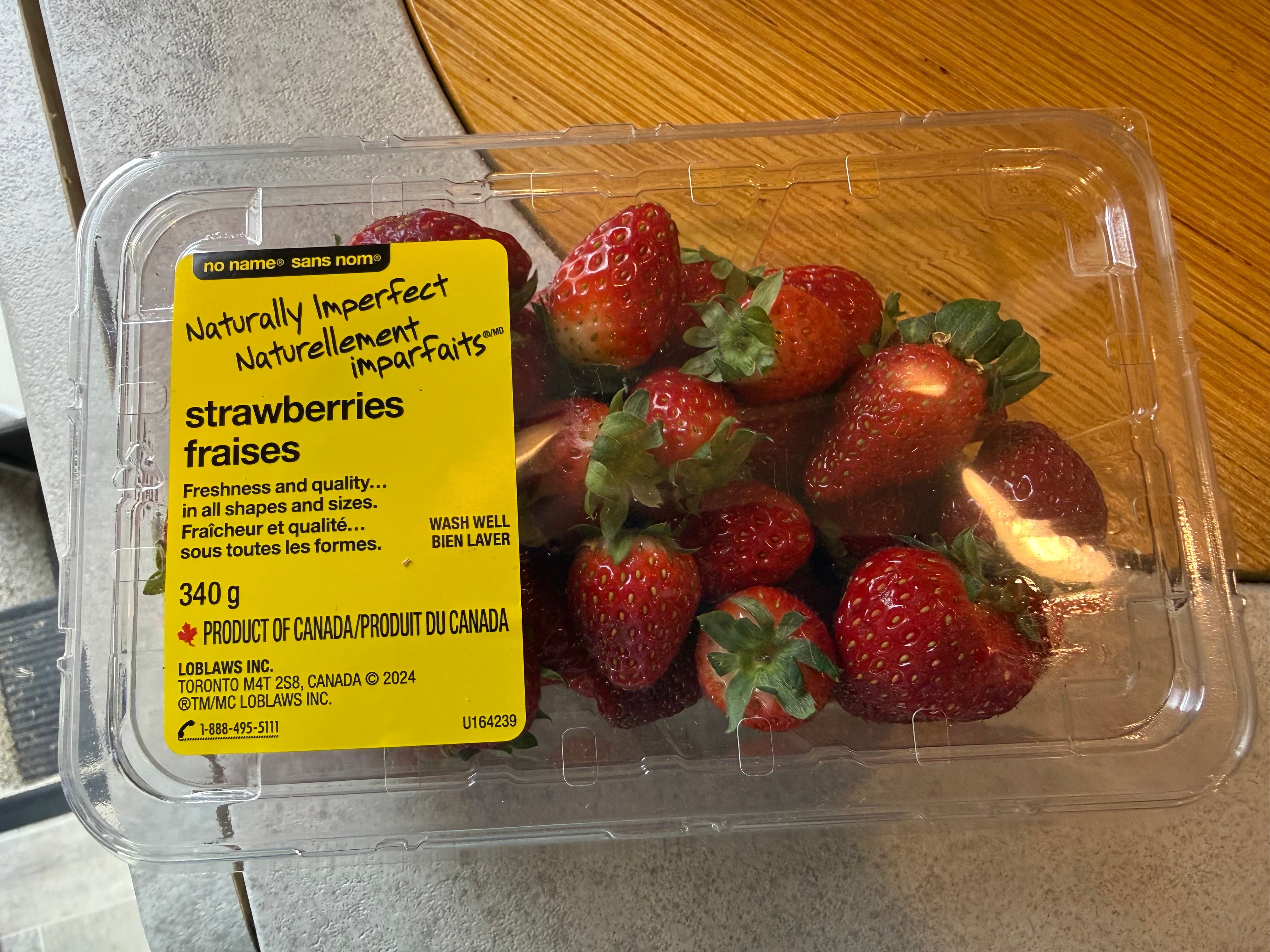
Shortly after we crossed the border from America into Canada, we pulled into a grocery store for our post-border shop. Food, for me, is part of the traveling experience, so I strolled the aisles looking for new (to me) offerings.
The strawberries caught my eye largely because they had the “product of Canada” label. “Really,” I thought. “Strawberries grow in Canada?” Then I saw this: Naturally Imperfect.
Most food packaging attempts to persuade buyers that what lies inside is flawless. I have become accustomed to produce selected for uniform size, identical shape, and visual consistency.
Rather than apologizing for strawberries that varied in appearance, this label embraced the reality that living things do not emerge from the earth in perfect symmetry. One berry was larger than another. One carried an unusual contour. Another leaned slightly to one side. They were not identical because they were alive.
Looking at the container, I began thinking about the opening chapter of Genesis. Repeatedly, after each act of creation, God pauses to observe what has been made. “And God saw that it was good.”
The text does not say God saw that it was perfect. It does not suggest that every tree was identical, every mountain symmetrical, or every creature free from variation. Instead, God saw goodness.
That distinction matters because human beings often confuse goodness with perfection.
We imagine that a good life is a flawless life. A good family is one without conflict. A godly church is one without disagreement. A good body is one untouched by age. A good faith is one without questions.
Yet creation itself claims otherwise.
The natural world is gloriously irregular. Trees twist toward sunlight. Marshes shift with the tides. Rivers carve unexpected channels through the landscape. The heavens declare the glory of God without ever achieving geometric precision.
Creation is dynamic rather than static. Alive rather than manufactured. Good rather than perfect.
Somewhere along the way, many of us absorbed the notion that our imperfections disqualify us from goodness. We carry scars, regrets, limitations, failures, and unfinished stories. We compare ourselves to re-touched images and conclude we have somehow fallen short of what we were meant to be.
We have misunderstood the assignment.
The first chapter of Genesis does not present a world optimized for efficiency. It presents a world overflowing with diversity, abundance, and possibility. Deserts and forests coexist. Mountains rise while valleys descend. Countless forms of life fill sea, sky, and land.
When God surveys this astonishing creation, the verdict is not perfection. The verdict is goodness.
That observation becomes even more profound when we remember that creation is unfinished. The biblical story begins not with completion but with participation. Gardens require tending. Relationships require cultivation. We humans continue growing, learning, and becoming.
Goodness does not require completion. Goodness exists within the process itself.
This truth becomes easier to see as we age.
The young often pursue perfection because they imagine life is a destination. Elders discover that life is more like a trail. We accumulate experiences, joys, griefs, wisdom, and scars. We become weathered by love and loss alike.
The resulting people rarely resemble the idealized version imagined decades earlier. Yet the weathered version is often more beautiful. The face tells a story. The scar speaks of survival. The wrinkle reflects laughter. The gray hair reveals endurance. The imperfections become evidence of a life genuinely lived.
Perhaps that is why the strawberry package felt unexpectedly profound.
Those berries did not need to become identical to possess value. Their irregularities testified to their authenticity. They were naturally imperfect.
And they were good.
The God of Genesis looked upon a world filled with diversity, unpredictability, and ongoing development and declared it good.
We should be slower to condemn in ourselves what God never required in creation.