Everyday Pride
Most of life consists of ordinary encounters with people whose experiences, beliefs, and assumptions differ from our own.

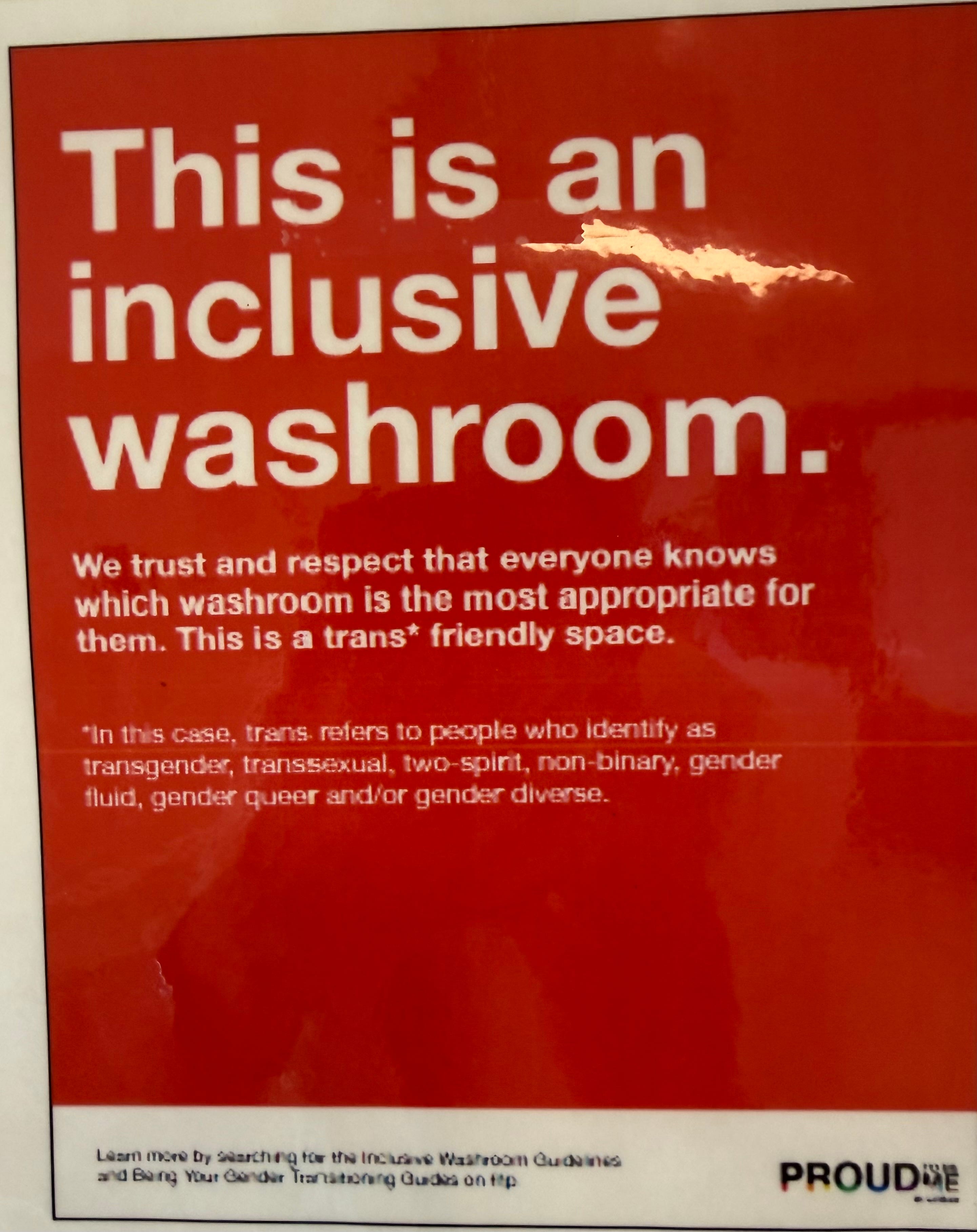
A small sign on a washroom door of a large Canadian grocery franchise stopped me in my tracks last week. The message reminded me that corporate kindness still exists and made me wish we saw more examples of it in public life.
The sign explained that the store had an inclusive washroom. People were trusted to determine which washroom was most appropriate for them, and the space was described as trans-friendly.
I took this photograph and later posted it on social media with two words: everyday pride.
Among the responses was a comment from my friend Kim. “Mutual respect can be such an easy thing.” The message isn’t about legislation or a campaign slogan. It is simply a marker of how one corporate community had chosen to organize ordinary life.
More importantly, it assumes that most people are capable of sharing space.
We live in a time when disagreement is increasingly treated as an emergency. Public discourse trains us to sort every issue into opposing camps and prepare for battle. Every question becomes a test of loyalty. Every difference becomes evidence of threat. Every disagreement arrives accompanied by pressure to declare which side deserves our outrage.
Yet most of life is not lived in the realm of grand ideological conflict.
Most of life happens in grocery stores, parks, libraries, schools, restaurants, churches, sidewalks, and public restrooms. This shared life consists of ordinary encounters with people whose experiences overlap with ours in some ways and differ in others.
The challenge of community has never been discovering how to live with people exactly like ourselves. That requires very little maturity. The challenge is learning how to coexist with people who see the world differently.
Families depend upon this skill. Congregations depend upon it. Democracies depend upon it. Every healthy community eventually discovers that agreement and respect are not identical concepts.
Agreement concerns ideas. Respect concerns people.
A person can disagree deeply with kindness, dignity, and restraint. Likewise, perfect agreement does not guarantee respect. Human history contains countless examples of people who shared the same beliefs while treating one another terribly.
Mutual respect begins with a simple recognition: Every person we encounter is more than a category, a voting bloc, a demographic label, or a cultural symbol.
We are all human.
That is why Kim’s comment is so wise.
“Mutual respect can be such an easy thing.”
Not always easy, of course. Some conflicts are profound. Some differences involve genuine moral disagreement. Some questions deserve careful debate and thoughtful discernment. But in the ordinary rhythms of daily life, respect is often far less complicated than we imagine.
It can look like allowing another person to move through the world without turning every encounter into a referendum. It can look like curiosity instead of suspicion. It can look like kindness instead of contempt.
A culture that rehearses outrage develops outrage reflexes. A culture that rehearses suspicion develops suspicion reflexes. A culture that rehearses respect develops respect reflexes.
Eventually these habits become part of the social atmosphere. People stop noticing them because they become normal.
That may be the most interesting thing about the sign I photographed.
The sign itself was not shouting. It was not demanding attention. It was simply part of the landscape, communicating expectations about how people would share space with one another.
In that sense, the most significant word in my original post may not have been pride. It may have been everyday.
Healthy communities are rarely built through extraordinary gestures alone. They are built through thousands of ordinary decisions to treat one another with dignity.
Mutual respect is not complicated public policy. It is not a grand social theory. It is simply one of the small habits that makes it possible for millions of strangers to share a country, a neighborhood, and a Tuesday.